
Review: The Things You Kill
A surreal look at how grief distorts our realities

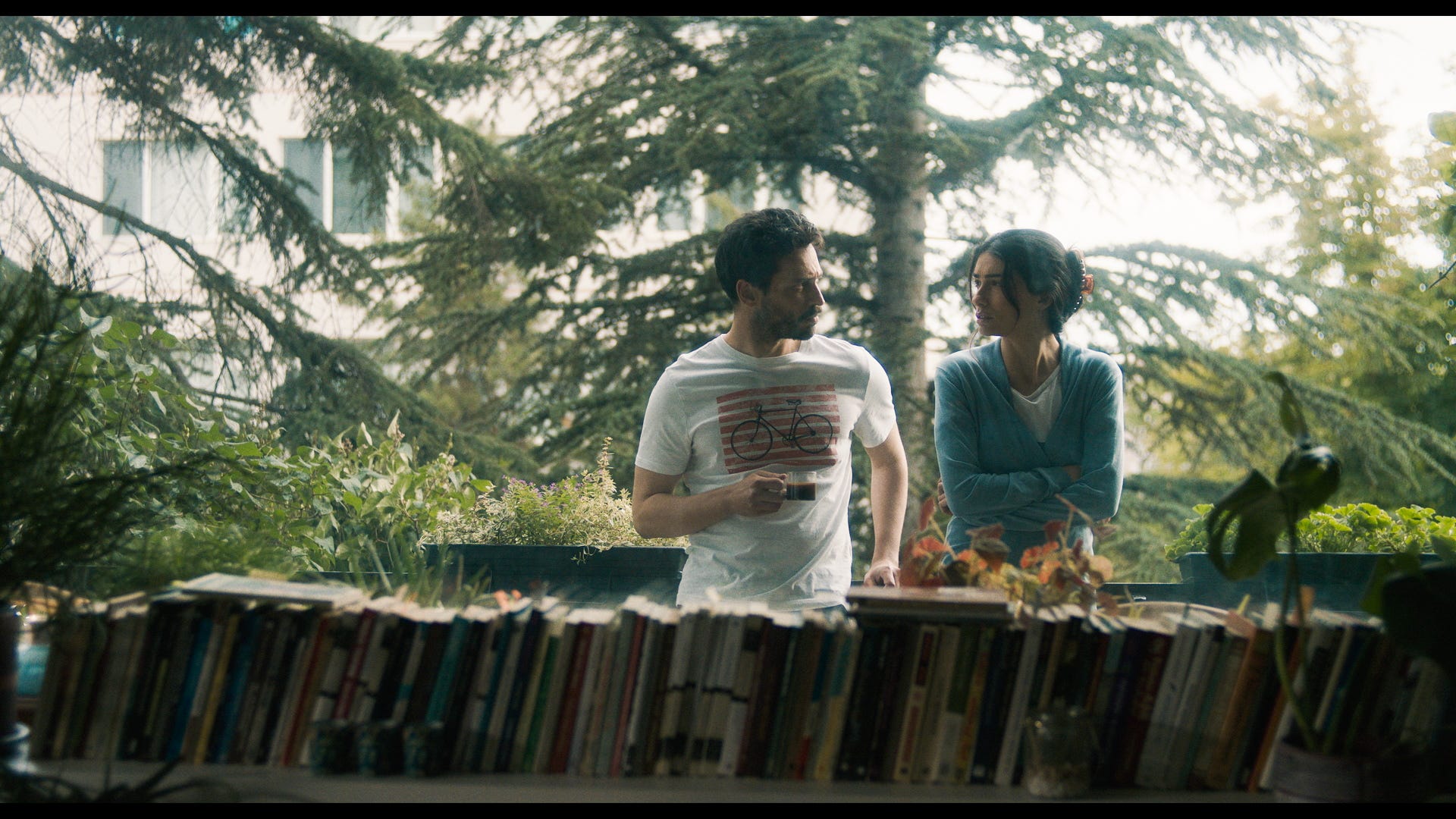
When director Alireza Khatami was censored from featuring his home country of Iran in this semi-autobiographical film, he had to substitute the location for Turkey. Another country where lies give someone a leg up on another, or as a student in the film says, “rumours are more believable in this town.” This contextual misdirection is one of the many reality distortions in The Things You Kill, which slowly reveals itself to be a surreal exploration of grief and familial lineage.
The opening scene presents a dream to the audience right away. A couple walks from their kitchen to the apartment balcony drinking their morning coffees, and the wife starts sharing a dream she had. She was asleep at her father-in-law’s house and awoken by her father-in-law pounding on the front door. The way the wife tells the story is almost as if she had actually experienced it, making the conversation itself feel like a dream to the audience. The entire scene is also viewed through the apartment’s window, looking out to the balcony, creating another layer of separation and distortion. A lack of score and wide shots throughout add to the unsettlingly distant nature of the film, which is heavily influenced by such masters in the thriller genre, such as Alfred Hitchcock and David Lynch.
Ali serves as a stand-in character for Khatami, who is a part-time professor at the local university, while tending to a garden and looking after his mother during his spare hours. Guilt begins to consume Ali when he quarrels with his father, who is abusive towards his mother, contemplating how best to care for her in the future. Many variables are forcing Ali to change and become a husk of what he is. He can’t conceive with a low sperm count, the university is considering cancelling the course he teaches, the garden is dying, trails of the truth behind his mother’s death are suddenly unearthed, and Ali’s father is possibly behind it.
These complications are echoed in the classroom when Ali is teaching a class about translation, defining it as guiding something into the beyond. It’s seemingly inevitable that Ali’s mother is going to pass on. His father’s abusiveness may not be helping, but he has to find a “translation” of who he wants to be when receiving the bad news. When one of his students suggests that the Arabic root for “translation” is also “to kill,” the answer to what Ali’s response to this bad news is quickly unearthed; he instinctively refuses to believe the notion.
Transforming ourselves after being affected by traumatic events and experiences is not only additive to our personality, but also kills something that once was. It’s not only the mother who has to “be killed” and brought to a better “beyond,” but Ali’s personality is also translated as he runs away from reality and meets a like-minded, yet aggressive, wanderer named Reza. Slowly, Ali starts adapting the same hostile qualities as his father, which is something he tried to prevent when he left to study in the United States. When secrets of Ali’s family begin to surface, it begins to seem that this transformation is somehow a necessary right of passage for becoming a man that he has been running from his whole life.
The Things You Kill points to how it isn’t our nature that causes us to do bad things, but it is rather a history of injustices sustained that slowly takes over our best intentions. Ali seems to have dodged his family’s drama for some time. He is seen early in the film, freshly groomed in a modern apartment with a beautiful wife. Through classical surreal filmmaking means, Ali slowly morphs into Reza (a conjunction of the director’s name, signalling an alter-ego). Comparitively Reza is balding and animalistic in the way he shouts at his siblings. Every single ounce of decency that Ali tried to build up to mask his troubled childhood cracks, and ultimately gets destroyed.
After some time digging around, asking questions as to who his parents really were and what made them into the people they became, Ali begins to understand where the familial similarities begin and where new ones could flower going forward. He finally doesn’t have to be a mix of different identities, Turkish-American, Ali/Reza, but can be a singular person, for the good of his loved ones, and, hopefully, his unborn child. It’s in the acceptance of Ali’s multitudes that allow him to know his limits and not be scared of them any longer.
Khatami’s strengths in his highly personal film are seen in the way he can accurately translate his own experience into a surprisingly resonant tale of self-discovery. The characterization of Reza comes across as a bit too cartoonishly evil when brushing up against the subtle thematic dramatization revolving around the “surreal translation” proceedings. Jumping between Ali and Reza features many severe tonal shifts in how each character looks and acts that strain the immersion. The surreal moments are not woven into the plot as succinctly as a Lynch or Hitchcock film, but for this singular perspective, it’s at least unique.
The Things You Kill was Canada’s 2026 Oscar entry for Best International Feature Film. It opens March 20 in Toronto (TIFF Lightbox), Vancouver, Montreal and other cities.
For more reviews, subscribe to The Ferryman and follow @robatss on Letterboxd